Does muscle burn more calories than fat?
Yes, about three times as much, but the numbers are small. At rest a pound of muscle burns about 6 calories a day and a pound of fat about 2. Add 5 pounds of muscle and you burn about 30 more a day. Muscle’s real value on a diet is different: it’s the weight you want to keep while the fat goes.
Muscle is busy tissue, and lifting burns plenty while you lift. So it’s easy to picture big muscles running hot all day. At rest, they mostly idle.
The simple version
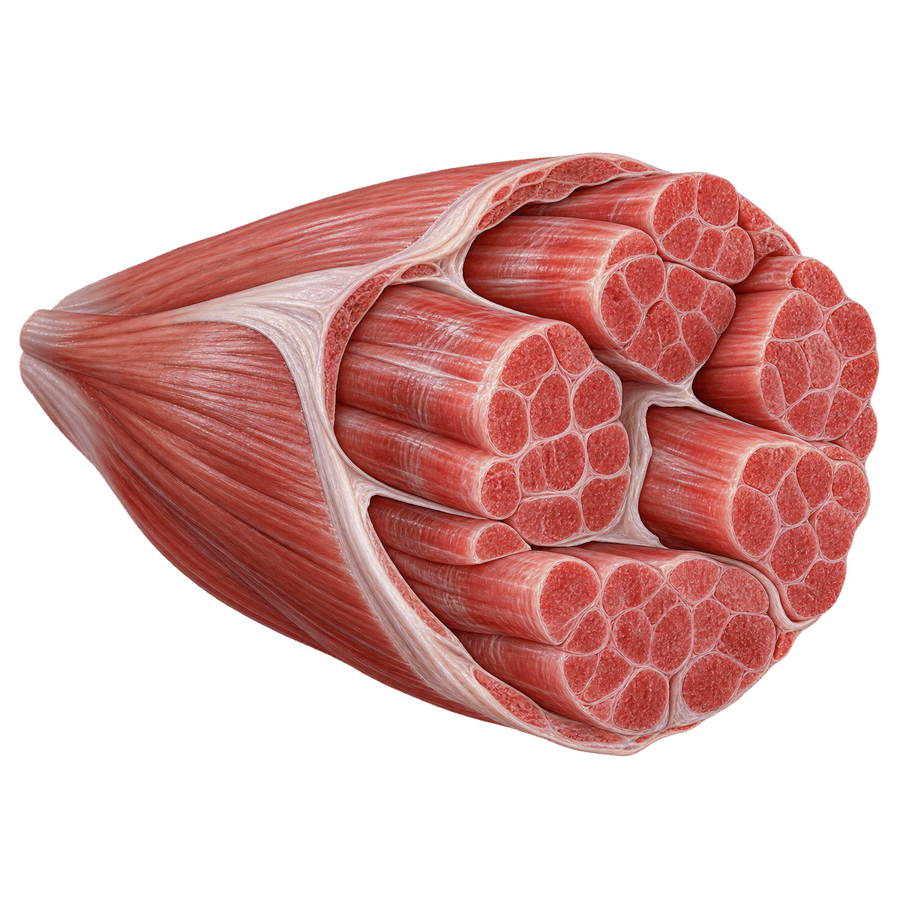
Muscle is a parked truck with the engine ticking over. Fat is a parked bike. The truck uses more, but neither uses much while parked. The ones running hot are your organs.
The numbers
| Tissue | Calories a day at rest, per pound | Per kilogram |
|---|---|---|
| Heart and kidneys | about 200 | 440 |
| Brain | about 110 | 240 |
| Liver | about 90 | 200 |
| Muscle | about 6 | 13 |
| Fat | about 2 | 4.5 |
These are the standard figures from a 1992 review by Elia. A 2010 study checked them against MRI scans and resting measurements in 131 adults. They held for adults up to 50 and ran about 3% high for people over 50.
Why keep muscle anyway
Muscle is what holds you up, carries your shopping and keeps you strong as you age. When you eat less, some of the weight you lose can come from it: in a 2014 review of lean, trained lifters on a diet, 9 of 13 study groups lost lean mass. In a 2011 trial of elite athletes who lifted weights four times a week while dieting, the slower losers gained about 2% lean mass, and the faster losers gained none.
What to do
- Lift weights while you diet, and lose at a pace you can hold.
- Eat enough protein: 1.2 to 1.6 grams per kilogram of body weight a day is typical. The protein calculator gives yours.
4 sources
- Wang et al., Specific metabolic rates of major organs and tissues across adulthood: evaluation by mechanistic model of resting energy expenditure, American Journal of Clinical Nutrition, 2010pubmed.ncbi.nlm.nih.gov
- Garthe et al., Effect of two different weight-loss rates on body composition and strength and power-related performance in elite athletes, International Journal of Sport Nutrition and Exercise Metabolism, 2011pubmed.ncbi.nlm.nih.gov
- Helms, Zinn, Rowlands and Brown, A systematic review of dietary protein during caloric restriction in resistance trained lean athletes: a case for higher intakes, International Journal of Sport Nutrition and Exercise Metabolism, 2014pubmed.ncbi.nlm.nih.gov
- US Department of Agriculture and US Department of Health and Human Services, Dietary Guidelines for Americans, 2025 to 2030, protein, checked 2026-11-10realfood.gov