
How much protein should I eat in a calorie deficit?
Most people eating less do well on 1.2 to 1.6 grams of protein per kilogram of body weight a day, the range in the US Dietary Guidelines. At 180 pounds that’s about 100 to 130 grams. Under that is too low, and many people are. Lean people who lift hard need more. The Gyroscope app personalizes yours. These ranges show you if you’re too low.
When you cut calories, it’s natural to cut everything a little. Protein is the one line to protect. When you eat less, some of the weight that comes off is lean mass, not just fat: in a 2010 diet study, even the well-rested group lost about 3.3 pounds of it in two weeks. Protein and lifting push your body to spend fat instead.
The simple version
A diet is a budget cut. Protein is the line that pays for the staff. Cut the snacks and the extras, and keep paying the staff.
The ranges
| You | Too low | Typical |
|---|---|---|
| 130 pounds | under 70 g | 70 to 95 g |
| 180 pounds | under 100 g | 100 to 130 g |
| 240 pounds, goal 180 | under 125 g | 125 to 165 g |
If you have more than a fifth of your weight to lose, count from your goal plus a fifth of what you weigh now. That’s why the last row isn’t counted from 240. Lean people who lift hard on a diet need 2.3 to 3.1 grams per kilogram of lean mass, the part of you that isn’t fat, in a 2014 review. For a 180-pound man at 15% bodyfat, that’s about 160 to 215 grams.
Why so many people are low
Protein needs a little attention, and it slips with age. In a US national survey of 11,680 adults over 50, up to 46% of the oldest ate less than even the old minimum of 0.8 grams per kilogram. It also costs the most to digest: 20 to 30% of its calories go to processing it.
What to do
- Find your range on the protein calculator, then aim for the middle of it.
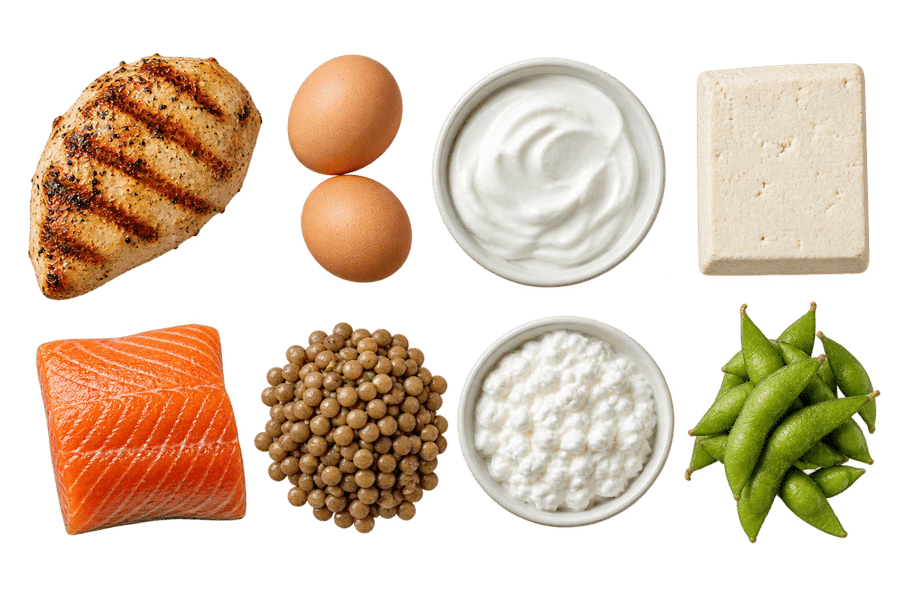
- Put protein first at every meal: eggs, Greek yogurt, fish, chicken, beans, tofu.
- If you have kidney disease, your doctor sets the number.
5 sources
- US Department of Agriculture and US Department of Health and Human Services, Dietary Guidelines for Americans, 2025 to 2030, protein, checked 2026-11-10realfood.gov
- Helms, Zinn, Rowlands and Brown, A systematic review of dietary protein during caloric restriction in resistance trained lean athletes: a case for higher intakes, International Journal of Sport Nutrition and Exercise Metabolism, 2014pubmed.ncbi.nlm.nih.gov
- Westerterp, Diet induced thermogenesis, Nutrition and Metabolism, 2004pubmed.ncbi.nlm.nih.gov
- Krok-Schoen et al., Low dietary protein intakes and associated dietary patterns and functional limitations in an aging population: a NHANES analysis, Journal of Nutrition, Health and Aging, 2019pubmed.ncbi.nlm.nih.gov
- Nedeltcheva et al., Insufficient sleep undermines dietary efforts to reduce adiposity, Annals of Internal Medicine, 2010pubmed.ncbi.nlm.nih.gov
