Does a pound of muscle burn 50 calories a day?
Short answerNo
On this page
No. At rest, a pound of muscle burns about 6 calories a day and a pound of fat about 2, by tissue rates checked against MRI scans in 2010. Gaining 5 pounds of muscle adds about 30 calories a day at rest. Lift anyway: in trials, lifting raised resting burn by about 96 calories a day, and muscle is what lets you move.
What we’d do
Lift weights two or three days a week, for the strength, for keeping muscle while you lose fat, and for the extra burn the training itself brings. Don’t count on new muscle to burn off food while you sit. The calories that matter come from moving that muscle: walking, carrying, climbing stairs. Set your food from your measured maintenance, not from how much muscle you hope to add.
If you remember three things
- A pound of muscle burns about 6 calories a day at rest. A pound of fat burns about 2.
- Your organs burn most of your resting calories. A pound of heart or kidney burns about 200 a day.
- Lifting raises resting burn by about 100 a day in trials. More than the new muscle alone explains.
Why it sounds right
Part of it is true. Muscle is busy tissue and fat is mostly storage. A lean, muscular person burns more than someone of the same weight with more fat. And the lean-mass formulas seem to say so: Katch-McArdle adds about 9.8 calories a day for every pound of lean mass, and many calculators pass that on as the burn of a pound of muscle.
The catch is in the word lean. Lean mass is everything that isn’t fat: muscle, but also your heart, liver, kidneys, brain, bones and blood. The formula’s 9.8 calories is an average across all of it, and the organs pull that average up a long way. The 50 calorie figure has no study behind it that we could find.
The idling car
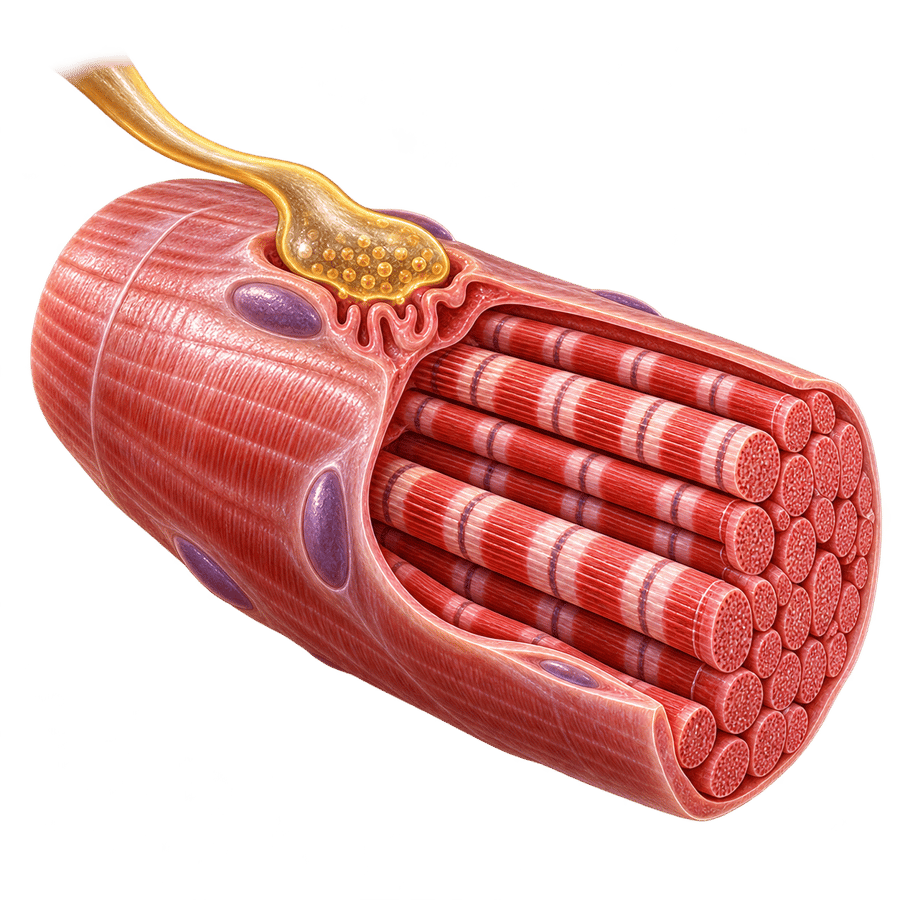
Muscle at rest is like a parked car with the engine idling. It burns a little fuel just waiting. When you drive it, it burns a lot. A bigger engine idles slightly higher, and it’s the driving that empties the tank.
What each tissue burns
Strong These rates were proposed in 1992 and checked in 2010 against MRI scans of 131 adults’ organs and their measured resting burn.
| Tissue | Calories a day per kilogram, at rest | Per pound |
|---|---|---|
| Heart and kidneys | About 440 | About 200 |
| Brain | About 240 | About 109 |
| Liver | About 200 | About 91 |
| Muscle | About 13 | About 6 |
| Fat | About 4.5 | About 2 |
Pound for pound, your heart burns more than 30 times what muscle does. Muscle still matters, because you have a lot of it: men carry about 33 kg (73 pounds) of skeletal muscle on average and women about 21 kg (46 pounds), in an MRI study of 468 adults. At 13 calories a kilogram, that’s about 430 and 270 calories a day.
So gaining 5 pounds of muscle adds about 30 calories a day at rest. Swap 5 pounds of fat for 5 pounds of muscle at the same weight and it’s about 20.
Then why does lifting raise your burn?
Lifting against no exercise, pooled
18 studies of adults under 65, 2020. MacKenzie-Shalders and colleagues, Journal of Sports Sciences
Lifting raised resting burn by about 96 calories a day compared with controls, with a likely range of about 45 to 147. Aerobic exercise alone showed no clear rise.
The studies used different methods and many had a high risk of bias.
Ten weeks of lifting
A review of strength training’s effects, 2012. Westcott, Current Sports Medicine Reports
Ten weeks of resistance training may add about 1.4 kg (3 pounds) of lean weight, raise resting burn by about 7% and take off about 1.8 kg (4 pounds) of fat.
A narrative review, not a pooled analysis.
Three pounds of new muscle at 6 calories a pound is about 18 calories a day. A 7% rise on a resting burn of 1,600 is about 110. Most of that rise can’t come from the new muscle alone, so something about training itself likely accounts for the rest. Either way, lifting is worth it, and the payoff is about 100 calories a day in all, not 50 for every pound.
Where it’s partly right
Muscle is where the calories go when you move. Walking at about 3 miles an hour costs 3.8 times your resting rate in the 2024 Compendium of Physical Activities, and that’s muscle doing the work. More muscle lets you walk, carry and climb more, and keeps you moving as you age. Adults who don’t train lose 3 to 8% of their muscle a decade, by the 2012 review.
Muscle also matters while you lose weight. In a 2011 trial of elite athletes who lifted four times a week while dieting, the group that lost 0.7% of body weight a week gained 2.1% lean mass. The group losing twice as fast gained none. Keeping muscle won’t burn much at rest, and it’s what you want the scale to keep.
8 sources
- Wang et al., Specific metabolic rates of major organs and tissues across adulthood: evaluation by mechanistic model of resting energy expenditure, American Journal of Clinical Nutrition, 2010pmc.ncbi.nlm.nih.gov
- Cunningham, Body composition as a determinant of energy expenditure: a synthetic review and a proposed general prediction equation, American Journal of Clinical Nutrition, 1991pubmed.ncbi.nlm.nih.gov
- Westcott, Resistance training is medicine: effects of strength training on health, Current Sports Medicine Reports, 2012pubmed.ncbi.nlm.nih.gov
- MacKenzie-Shalders et al., The effect of exercise interventions on resting metabolic rate: a systematic review and meta-analysis, Journal of Sports Sciences, 2020pubmed.ncbi.nlm.nih.gov
- Janssen et al., Skeletal muscle mass and distribution in 468 men and women aged 18-88 yr, Journal of Applied Physiology, 2000pubmed.ncbi.nlm.nih.gov
- Herrmann et al., 2024 Adult Compendium of Physical Activities: a third update of the energy costs of human activities, Journal of Sport and Health Science, 2024pubmed.ncbi.nlm.nih.gov
- Compendium of Physical Activities, walking codespacompendium.com
- Garthe et al., Effect of two different weight-loss rates on body composition and strength and power-related performance in elite athletes, International Journal of Sport Nutrition and Exercise Metabolism, 2011pubmed.ncbi.nlm.nih.gov