
Measure your real TDEE in four weeks
On this page
Log everything you eat and weigh yourself most mornings for four weeks. Your real maintenance is your average daily intake plus what your weight trend lost: each pound a week down is about 500 calories a day. If your weight held flat, your average intake is your maintenance.
What we’d do
Pick four ordinary weeks, with no holiday and no new training plan. Eat the way you normally do, or at the middle of your calculator range. Log every meal on the day you eat it, weekends included, and weigh in every morning. At day 28, do the arithmetic below, or let the real TDEE calculator do it. Then trust that number over any formula or watch, and redo it every 10 to 15 pounds.
If you remember three things
- Maintenance = your average intake + 500 for every pound a week you lost. Take it off instead if you gained.
- Use the trend, never two single mornings. Compare your first week’s average weight with your last week’s.
- Keep logging the same way. Your number is measured in your own log’s units.
Why can’t a calculator just tell you?
A calculator works from a population. The best formula is more than 10% off for about one person in five, the activity word is a guess, and watches miss calories by 20% or more. None of them has seen you eat or stepped on your scale.
Estimating your maintenance from a calculator is like estimating your car’s gas mileage from its make and model. It’s a fair start. Fill the tank, drive your usual roads for a month and check the odometer, and you know your car’s real number. Four weeks of logs and weigh-ins are that month of driving.
The four weeks, step by step
- Pick four ordinary weeks. No holiday, no move, no new training plan. You’re measuring the life you’ll keep living.
- Eat normally, or at the middle of your range. Either works. The math corrects for whatever your weight does.
- Log every meal and drink, on the day. Weekends too. A photo at the table counts.
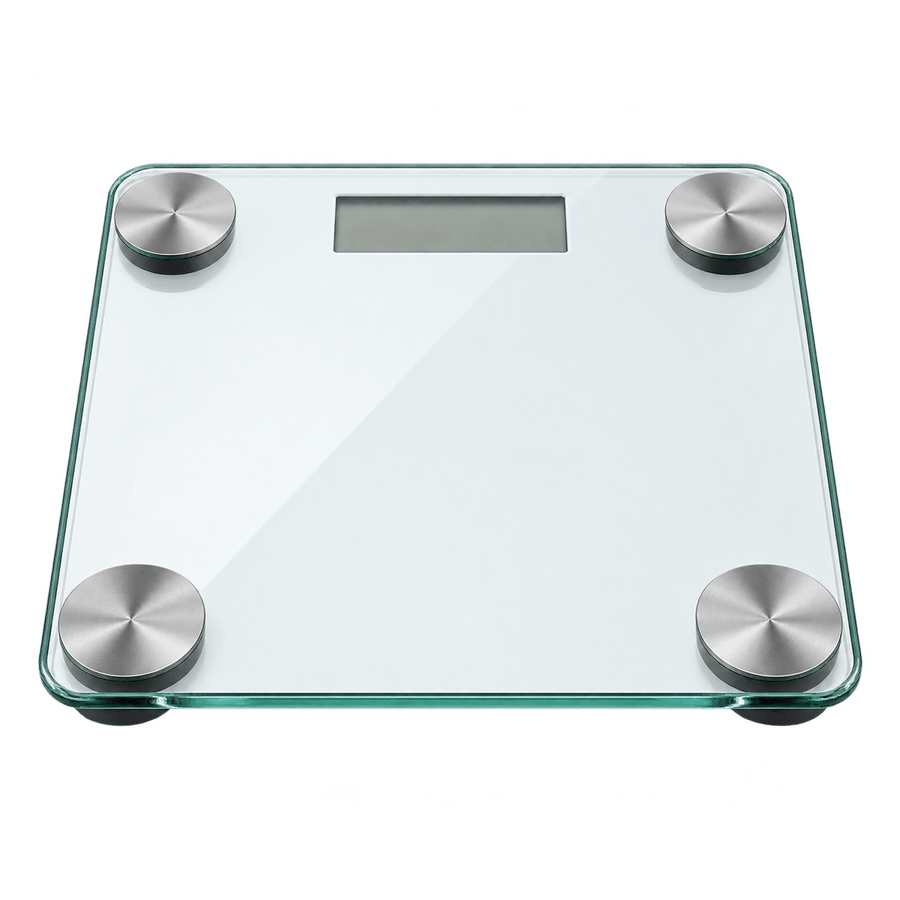
- Weigh in every morning. After the bathroom, before you eat or drink, on the same scale. A missed morning is fine. A missed meal in the log isn’t.
- Keep your steps and workouts as they are. They’re part of what you’re measuring.
- At day 28, do the arithmetic.
The arithmetic
- Your average intake. Add up 28 days of logged calories and divide by 28.
- Your weekly weight change. Average your first seven mornings and your last seven mornings. Their middles are three weeks apart, so divide the difference by 3.
- Turn it into calories a day. Each pound a week is about 3,500 calories a week, or 500 a day.
- Add it if you lost, take it off if you gained.
Here’s an example. You logged an average of 1,950 calories a day. Your first week’s mornings averaged 182.0 pounds and your last week’s 180.5. That’s 1.5 pounds in three weeks, or 0.5 a week, which is 250 calories a day. Your maintenance is about 1,950 + 250 = 2,200.
| Your weight trend | What to do | With 1,950 logged |
|---|---|---|
| Down 0.5 pounds a week | Add 250 | About 2,200 |
| Flat | Nothing | About 1,950 |
| Up 0.25 pounds a week | Take off 125 | About 1,825 |
The 3,500 rule dates from 1958. It’s close for people with a lot of fat to lose and too high for leaner people, whose lost pounds hold fewer calories. A steady weight needs no conversion at all, so the measurement is most exact when your weight barely moves.
The traps
The first week of a new diet is mostly water. Glycogen, the body’s carb store, is kept with three to four times its weight in water, and a 2012 study found the weight lost in the first month held fewer calories per pound than later. If you change how you eat at the start of the four weeks, the first week will make your maintenance look higher than it is. Start measuring while you eat as usual, or leave out the first week.
Weekends go missing. In a 2008 study, adults ate more on Saturdays and moved less on Sundays, enough to stop their weight loss on weekends. A log that’s complete Monday to Friday and thin on weekends will put your maintenance too low.
Every log runs low. In the OPEN study of 484 adults, people reported 12 to 20% fewer calories than they burned when asked what they ate the day before. The useful twist is that your measured maintenance is in the same units as your log. If you miss the same 15% next month, a target set from this number still works. If you start logging much more carefully, measure again.
One morning means little. Your weight swings from day to day with water. That’s why the method uses weekly averages, and why daily weighing helps rather than hurts. In a 2013 trial of 91 adults, the group given a smart scale for daily weighing lost 6.6% of their weight in six months, against almost none in the group that waited.
What to do with the number
- Use it in place of the calculator’s. Set your target from it on how many calories to eat to lose weight: about 500 under to start, never under your floor.
- Place the other numbers against it. If your watch averaged 2,600 and you maintain at 2,200, now you know your watch runs about 400 high for you.
- Redo it every 10 to 15 pounds. Each pound you lose lowers your maintenance by about 10 calories a day, by Kevin Hall’s model of body weight. Redo it too after a new job, a new commute or a new training block.
If the number looks too low
If your measured maintenance comes out under 1,200 calories a day for a woman or 1,500 for a man, the usual reason is a log that’s missing food, not a slow metabolism. In the 1992 study of people who said they couldn’t lose on 1,200 calories, their burn was within 5% of normal for their size, and they had under-reported what they ate by 47%. Don’t set a deficit below those levels without a doctor. The 2013 US obesity guideline’s diets start at 1,200 for women and 1,500 for men.
Tracking it in Gyroscope
In Gyroscope you photograph your meals, weigh in most mornings and let your steps come in from your phone or watch. A Withings or Apple Health scale syncs on its own, or you can photograph any scale’s display. Your meals and weigh-ins feed your energy balance, your weight trend gives a calorie-burn estimate, and your TDEE gets its own trend. More on tracking it.
More detail: the same arithmetic in kilograms
Maintenance = average intake + (kilograms lost per week × 1,100). The 1,100 is the usual 7,700 calories per kilogram divided by seven days. Lost 0.25 kg a week on 1,950 logged calories: 1,950 + 275 = 2,225.
A straight line fitted through all 28 mornings uses every weigh-in, not just the first and last weeks, and it’s what the real TDEE calculator does.
12 sources
- Frankenfield, Bias and accuracy of resting metabolic rate equations in non-obese and obese adults, Clinical Nutrition, 2013pubmed.ncbi.nlm.nih.gov
- Shcherbina et al., Accuracy in wrist-worn, sensor-based measurements of heart rate and energy expenditure in a diverse cohort, Journal of Personalized Medicine, 2017pmc.ncbi.nlm.nih.gov
- Wishnofsky, Caloric equivalents of gained or lost weight, American Journal of Clinical Nutrition, 1958pubmed.ncbi.nlm.nih.gov
- Hall, What is the required energy deficit per unit weight loss?, International Journal of Obesity, 2008pubmed.ncbi.nlm.nih.gov
- Hall et al., Quantification of the effect of energy imbalance on bodyweight, The Lancet, 2011pmc.ncbi.nlm.nih.gov
- Heymsfield et al., Energy content of weight loss: kinetic features during voluntary caloric restriction, Metabolism, 2012pubmed.ncbi.nlm.nih.gov
- Kreitzman, Coxon and Szaz, Glycogen storage: illusions of easy weight loss, excessive weight regain, and distortions in estimates of body composition, American Journal of Clinical Nutrition, 1992pubmed.ncbi.nlm.nih.gov
- Subar et al., Using intake biomarkers to evaluate the extent of dietary misreporting in a large sample of adults: the OPEN study, American Journal of Epidemiology, 2003pubmed.ncbi.nlm.nih.gov
- Lichtman et al., Discrepancy between self-reported and actual caloric intake and exercise in obese subjects, New England Journal of Medicine, 1992pubmed.ncbi.nlm.nih.gov
- Racette et al., Influence of weekend lifestyle patterns on body weight, Obesity, 2008pmc.ncbi.nlm.nih.gov
- Steinberg et al., The efficacy of a daily self-weighing weight loss intervention using smart scales and e-mail, Obesity, 2013pubmed.ncbi.nlm.nih.gov
- Jensen et al., 2013 AHA/ACC/TOS guideline for the management of overweight and obesity in adults, Circulation, 2014pmc.ncbi.nlm.nih.gov