
Is a slow metabolism why some people gain weight easily?
Short answerNot the way you think
Not the way you think. Bigger bodies burn more calories, not fewer, and when researchers measured people who said they couldn’t lose weight, their burn was normal for their size. People do differ, mostly in everyday movement: overfed the same extra food, some people stored ten times as much fat as others.
What we’d do
Assume your metabolism is normal until a measurement says otherwise. The odds are on your side. Then find your own number: four weeks of logged food and morning weigh-ins give you your real maintenance, whatever any formula says. Look hard at your steps, because that’s where people really differ. And if you also feel cold, tired and run down, ask your doctor to check your thyroid.
If you remember three things
- A bigger body burns more. Every extra kilogram adds about 10 calories a day at rest in the usual formula.
- A slow burn is rarely the reason. People sure they had one were within 5% of normal when measured.
- Movement is the real difference. It decided who gained fat when people were overfed.
Why it sounds right
Everyone knows someone who eats whatever they like and stays thin, and someone else who gains weight looking at bread. It seems obvious that some engines run hot and some run cold.
People do differ. But the difference is mostly not in the resting engine, and it often runs the opposite way to the story: the person with more weight usually burns more calories at rest, not fewer.
The heating bill
Think of two houses on the same street with the same furnace. One has a far bigger heating bill. The furnace isn’t the reason. The bigger house costs more to heat, and the family that leaves the back door open all day loses heat the other one keeps. Your body’s size is the house. Your movement through the day is the open door. The furnace, your resting metabolism, works about the same in both.
What the numbers show
Strong Resting and daily burn have been measured in thousands of people of every size.
Bigger bodies burn more. In the 498 adults behind the Mifflin-St Jeor formula, each extra kilogram of weight added about 10 calories a day of resting burn. In the 2021 study of 6,421 people, total daily burn rose steadily with lean mass. Even fat burns something, about 2 calories a pound a day at rest, by tissue rates checked in 2010.
People who say their burn is slow rarely have one. In 1992, researchers in New York measured ten people who said they couldn’t lose weight on under 1,200 calories a day. Their burn was within 5% of what their body composition predicted. They had under-reported what they ate by 47% and over-reported their exercise by 51%. The researchers ruled out a low burn.
Movement is where people split. In a 1999 Mayo Clinic study, 16 adults ate 1,000 calories a day more than they needed for eight weeks. Some stored ten times as much fat as others. The difference was everyday movement, fidgeting, standing and walking around, which rose a lot in some people and barely in others.
Where it’s partly right
Resting burn does vary between people of the same size. The best formula is more than 10% off for about one adult in five, some burning more than predicted and some less. On a resting burn of 1,600, that’s 160 calories a day or more, and by Kevin Hall’s model a steady 160 calorie gap is worth about 16 pounds over a few years. That’s real, and it’s why a measurement beats any formula for you.
There’s one more twist. In a 2021 study of 1,754 adults, people with more bodyfat made up a bigger share of the calories they burned in activity, by burning less at rest. The researchers couldn’t tell whether that comes before weight gain or after it.
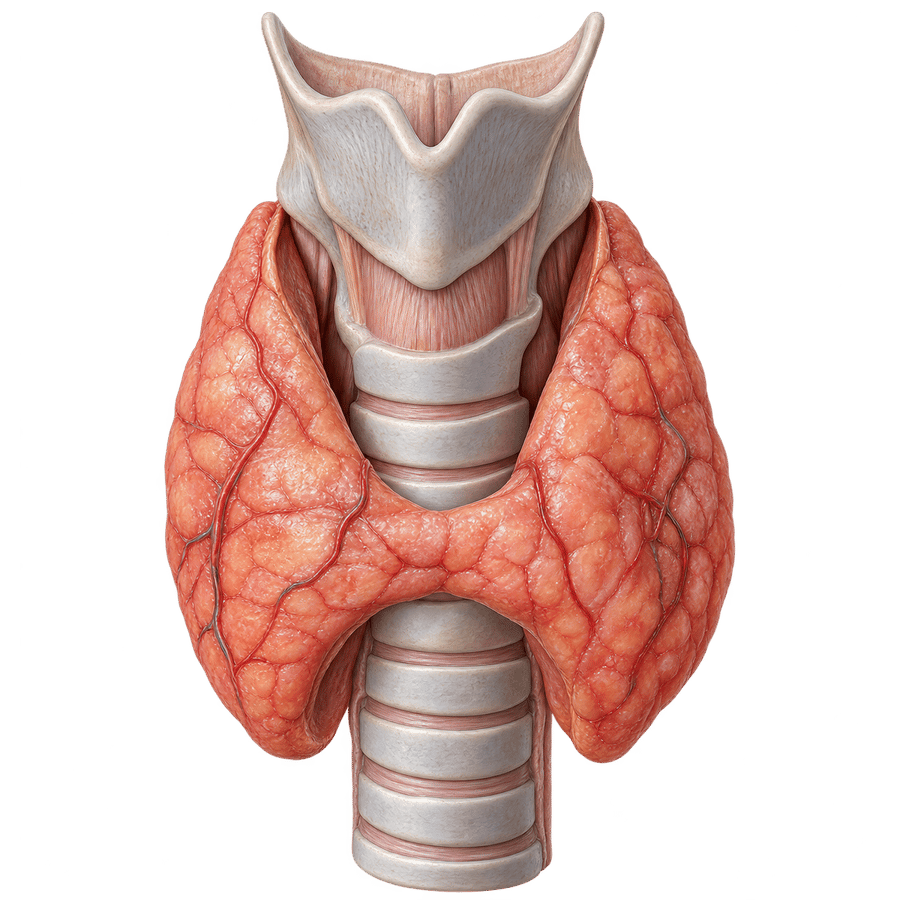
And some people do have a medical cause. Nearly 5 in 100 Americans aged 12 and older have an underactive thyroid, most of them mildly. Thyroid hormones control how your body uses energy, and without enough of them many functions slow down. Fatigue, weight gain and feeling cold are among the common signs, and a blood test settles it.
So your metabolism is very likely normal for your size, a bigger body burns more, and the biggest difference between people is how much they move. Measure your own number, then work on your steps.
9 sources
- Mifflin et al., A new predictive equation for resting energy expenditure in healthy individuals, American Journal of Clinical Nutrition, 1990pubmed.ncbi.nlm.nih.gov
- Pontzer et al., Daily energy expenditure through the human life course, Science, 2021pmc.ncbi.nlm.nih.gov
- Wang et al., Specific metabolic rates of major organs and tissues across adulthood: evaluation by mechanistic model of resting energy expenditure, American Journal of Clinical Nutrition, 2010pmc.ncbi.nlm.nih.gov
- Lichtman et al., Discrepancy between self-reported and actual caloric intake and exercise in obese subjects, New England Journal of Medicine, 1992pubmed.ncbi.nlm.nih.gov
- Levine, Eberhardt and Jensen, Role of nonexercise activity thermogenesis in resistance to fat gain in humans, Science, 1999pubmed.ncbi.nlm.nih.gov
- Frankenfield, Bias and accuracy of resting metabolic rate equations in non-obese and obese adults, Clinical Nutrition, 2013pubmed.ncbi.nlm.nih.gov
- Careau et al., Energy compensation and adiposity in humans, Current Biology, 2021pubmed.ncbi.nlm.nih.gov
- NIDDK, Hypothyroidism (underactive thyroid)niddk.nih.gov
- Hall et al., Quantification of the effect of energy imbalance on bodyweight, The Lancet, 2011pmc.ncbi.nlm.nih.gov
